2026_05_0 Release Notes
Release date: May 26, 2026
The release notes describe changes to Storefront for this release, including new features and enhancements. In addition to these changes, Instacart continually updates the platform to improve accessibility, performance, and stability and to ensure the best user experience for your customers.
Are you using the partner-pick model? Review the Shopper App release notes for recent updates.
New features
The following new features are available in this release.
Generate dynamic collections with AI (Storefront Pro 5)
You can now create product collections using plain-English prompts in Instacart Platform Portal. Describe the collection you want — for example, "healthy lunchbox ideas with items under $10" — and AI automatically generates a set of dynamic collection rules, such as Categories, Dietary Preferences, and Price rules, that define which products appear in the collection.
You can review and edit the AI-generated rules before saving the collection. AI quality assurance also checks the collection for relevance before you save, and the tool flags if a similar collection already exists.
- Currently the AI does not consider analytics data such as product sales performance when generating dynamic collection rules. For example, “top selling steaks” may not include your most popular products.
- The following dynamic collection rules do not work with AI collection prompts:
- Brands
- EBT/SNAP eligible
- Item Attributes
- Flyer
- Max Age (Days)
- Store Brand
For more information, see Manage collections.
Instacart collection template library (Storefront Pro 5)
Instacart now provides a library of pre-built collection templates created by Instacart category managers. Templates are designed for seasonal moments, trending categories, and curated themes. You can browse the template library, select a template, customize it for your store, and publish it on your digital storefront.
For more information, see Manage collections.
Redesigned Instacart Platform Portal navigation
We’re refreshing the Instacart Platform Portal navigation to make it easier to find the tools you need. Based on your feedback, the navigation has been redesigned with the following improvements:
- A cleaner, single left menu. The current top and left navigation is replaced with a single, collapsible left sidebar menu. This update reduces visual clutter and makes it easier to stay oriented as you move between tools.
- Merchandising & Marketing tools organized by Instacart solution. Merchandising and Marketing tools are now grouped by Instacart solution — Marketplace, Storefront, and Storefront Pro — so it's clear which tools apply to each solution, and you can get to the right place without guesswork.
- Dedicated settings menu. Settings are now in their own dedicated menu so that the main navigation stays focused on the tools you use most.
At this time you can try the new navigation, with the option to switch back to the classic navigation as you get oriented.
Click through the following video to learn more about the new navigation:
For more information, see the announcement in the Instacart Platform Portal documentation.
Digital flyers now available (Storefront Pro 5)
Digital flyers are now available as an alternative to clickable PDF flyers. Digital flyers are interactive, shoppable content pages that display your promotional items as product tiles organized by category, with dynamic pricing from your catalog. Dynamic pricing eliminates pricing discrepancies and removes the need for PDF updates. Customers can browse featured Great buys deals, explore items grouped by department, and add products to their cart directly from the flyer. You can create and manage digital flyers in Instacart Platform Portal, customize the theme and placements, and update content after publication. You can have multiple concurrent digital flyers with different schedules, such as weekly, bi-weekly, or monthly. Customers can also preview future flyers before they become active.
The following image shows a digital flyer page:
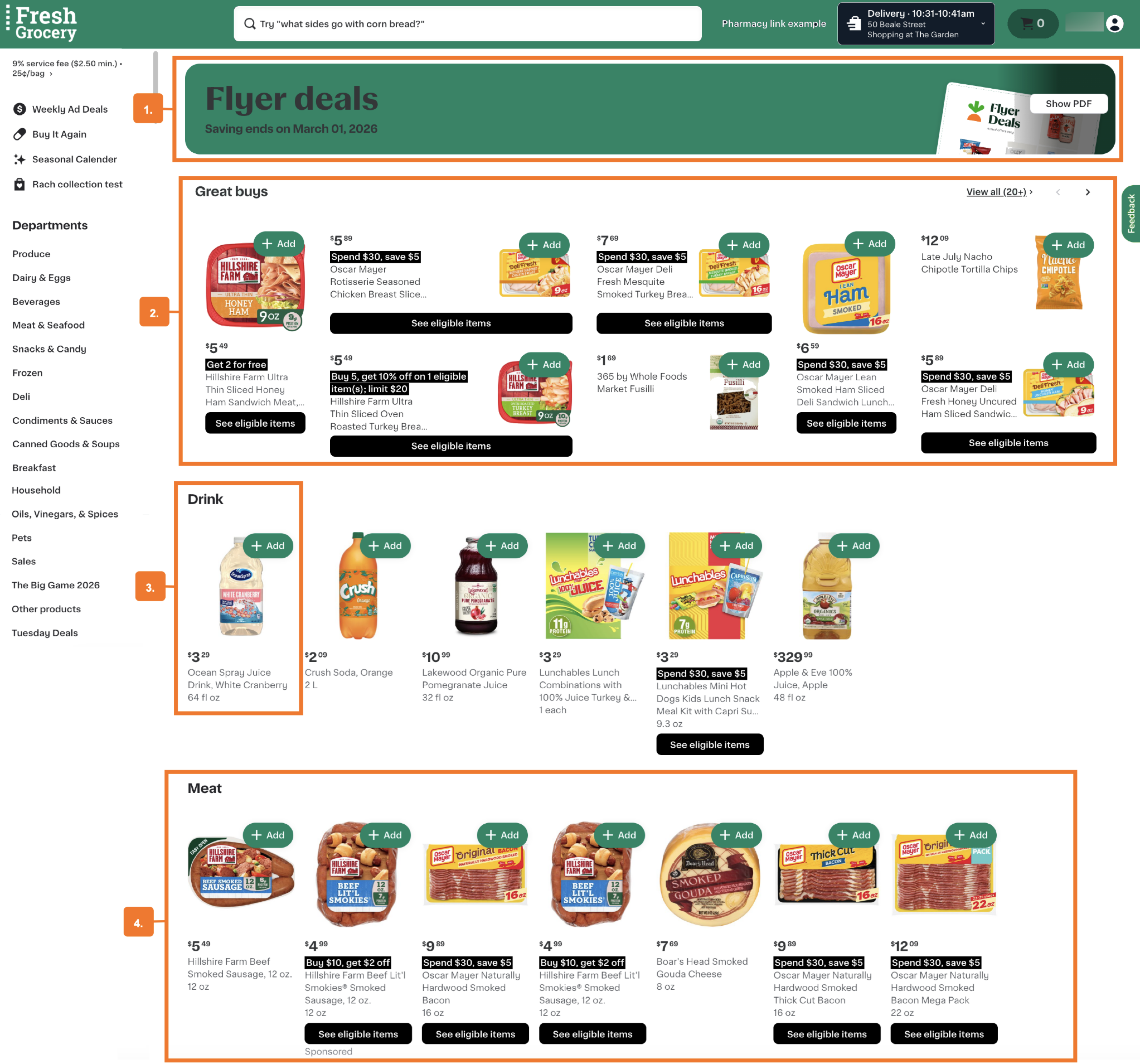
- Banner. A promotional banner image displays at the top of the page. If a PDF is available, customers can click Show PDF.
- Great buys. Featured products with the best deals appear prominently.
- Product tiles. Flyer items display with current pricing from your catalog. Customers can add items to their cart or click tiles to view product details.
- Category sections. Flyer items are organized by the product department, such as Drinks, Meat, Snacks, and Produce.
For more information, see Flyers.
Drop-off location for unattended deliveries
Customers can now see the exact location where their unattended order was dropped off. A map thumbnail appears on the order status page, pinned to the shopper's GPS location at the time the delivery photo was taken. Customers can tap the map to expand it and zoom in or out.
The map is displayed for unattended deliveries when the GPS accuracy of the shopper's device is 15 meters or better at the time the delivery photo is taken.
When a customer reports a wrong or missing order, the drop-off location map and delivery photo appear directly in the reporting flow. If the report is within 20 minutes of when the order was delivered, customers are prompted to contact their shopper via chat before being routed to Instacart Customer Experience.
For more information, see After fulfillment.
New discounting offer types (Storefront Pro 5)
The following offer types are now supported with Catalog inventory file promotions:
- Multi-group. Spend $X on Group A, get a free item from Group B. For example, spend $10 on lasagna noodles, get pasta sauce free.
- Multi-group. Spend $X on weighted Group A, get a free item from Group B. For example, spend $10 on ground beef, get pasta sauce free.
- Multi-group. Spend $X on Group A, get a weighted item from Group B for $Y per lb. For example, spend $50 on fresh meat, get ground beef for $3.88 per lb.
- Multi-group. Spend $X on Group A, get an item from Group B for $Y. For example, spend $60 on Seafood, get a Pepsi 12-pack for $0.01.
- Multi-group. Buy M from Group A, get an item from Group B for $X. For example, buy 2 Sunbelt Granola Bars, get a gallon of milk for $1.99.
For more information, see Complex product+collection offers and Promotional offer types and metadata examples.
View multiple offers per item
Multiple offer types, including retailer-funded, CPG-funded, and Instacart-funded promotions, can now apply simultaneously to a single item, giving customers maximum visibility into all available savings. When an item has multiple offers, item tiles display a See all N offers button, which customers click to display a new offer sheet that lists every available promotion for that item, along with a progress indicator and a grid of eligible items for each offer.
Product detail pages now include a dedicated offers section where customers can view progress toward each promotion and navigate into its eligible items list.
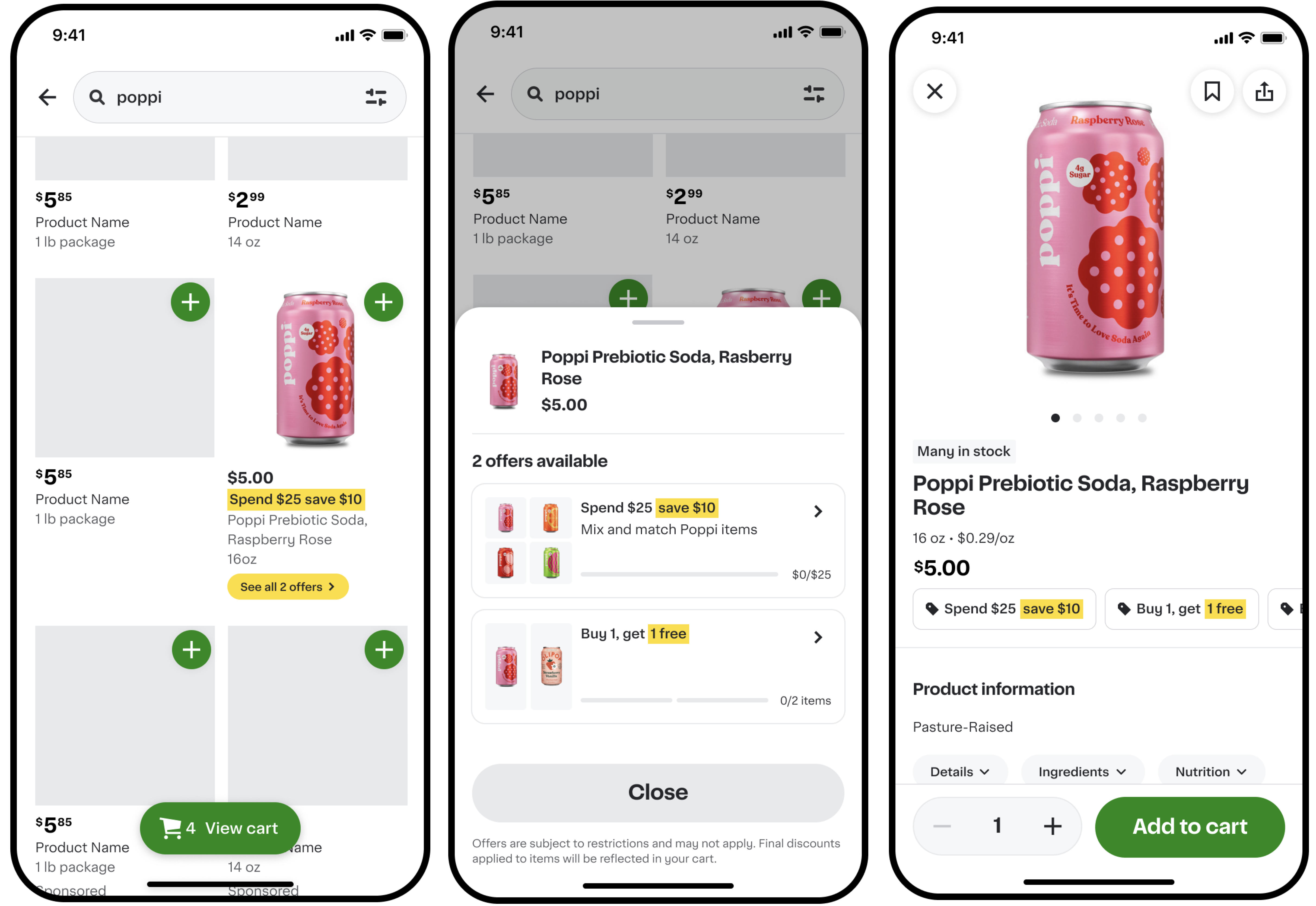
This feature is available on mobile web, iOS, Android, and desktop. To enable multiple offers per item, contact your Instacart representative.
For more information, see Multiple offers per item.
Customizable banners at checkout (Storefront Pro 5)
You can now display secondary banner carousels on the checkout page of your storefront. Banners can promote campaigns and link customers to a destination page.
The following image shows a secondary banner carousel on a mobile app checkout screen:
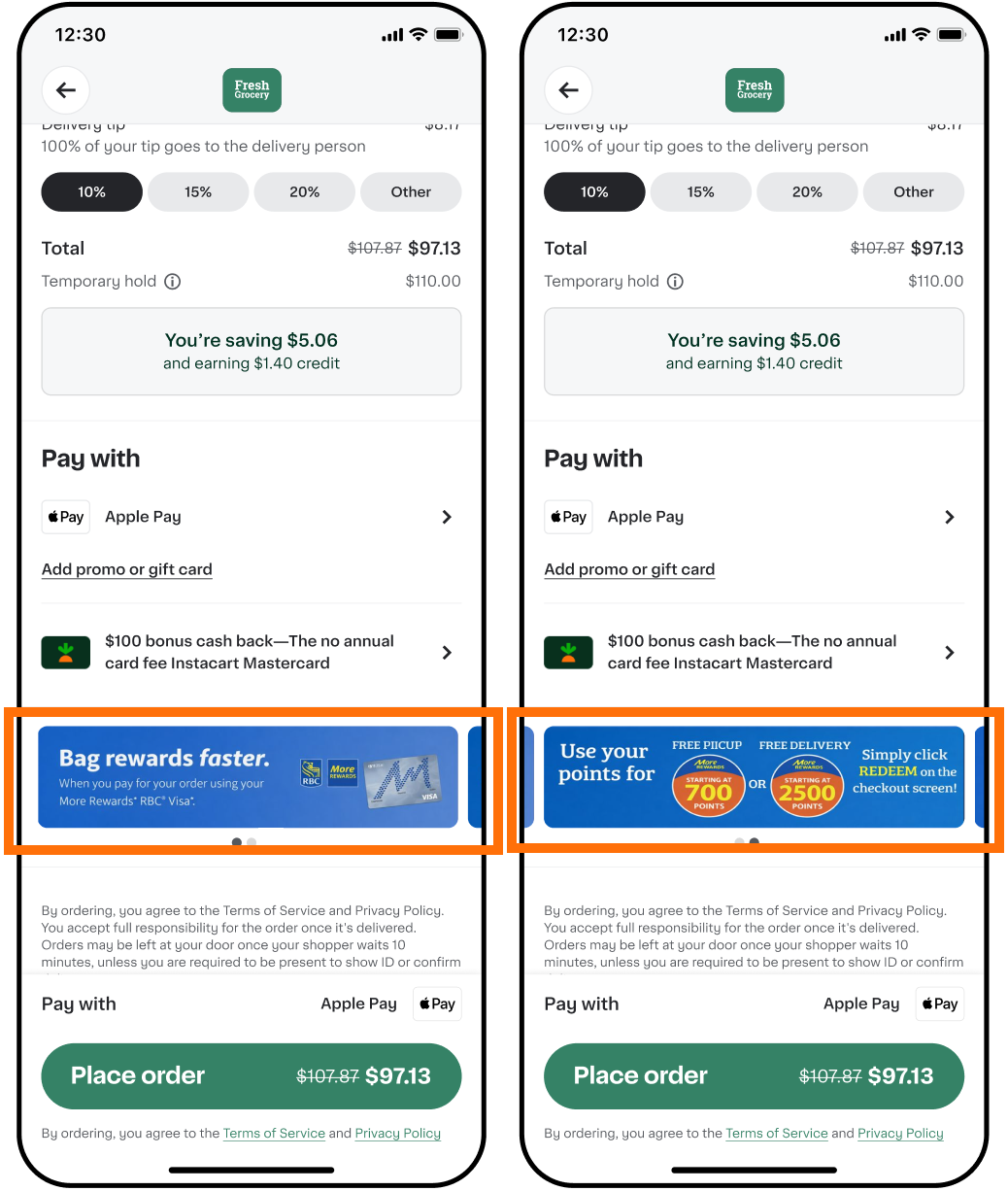
For more information, see Create drive awareness campaigns.
Card carousels in dynamic slots (Storefront Pro 5)
You can now add Card carousels to dynamic slots on content pages and custom homepages with Drive awareness campaigns. By assigning a campaign to a slot, you control when the cards appear and which customers see them — the campaign's segmentation and scheduling rules determine the audience and timing of each placement. You can set carousel-level styling for all cards in the dynamic slot, including text alignment, card colors, and call-to-action style.
The following example shows a horizontal card carousel in a dynamic slot on a custom homepage:
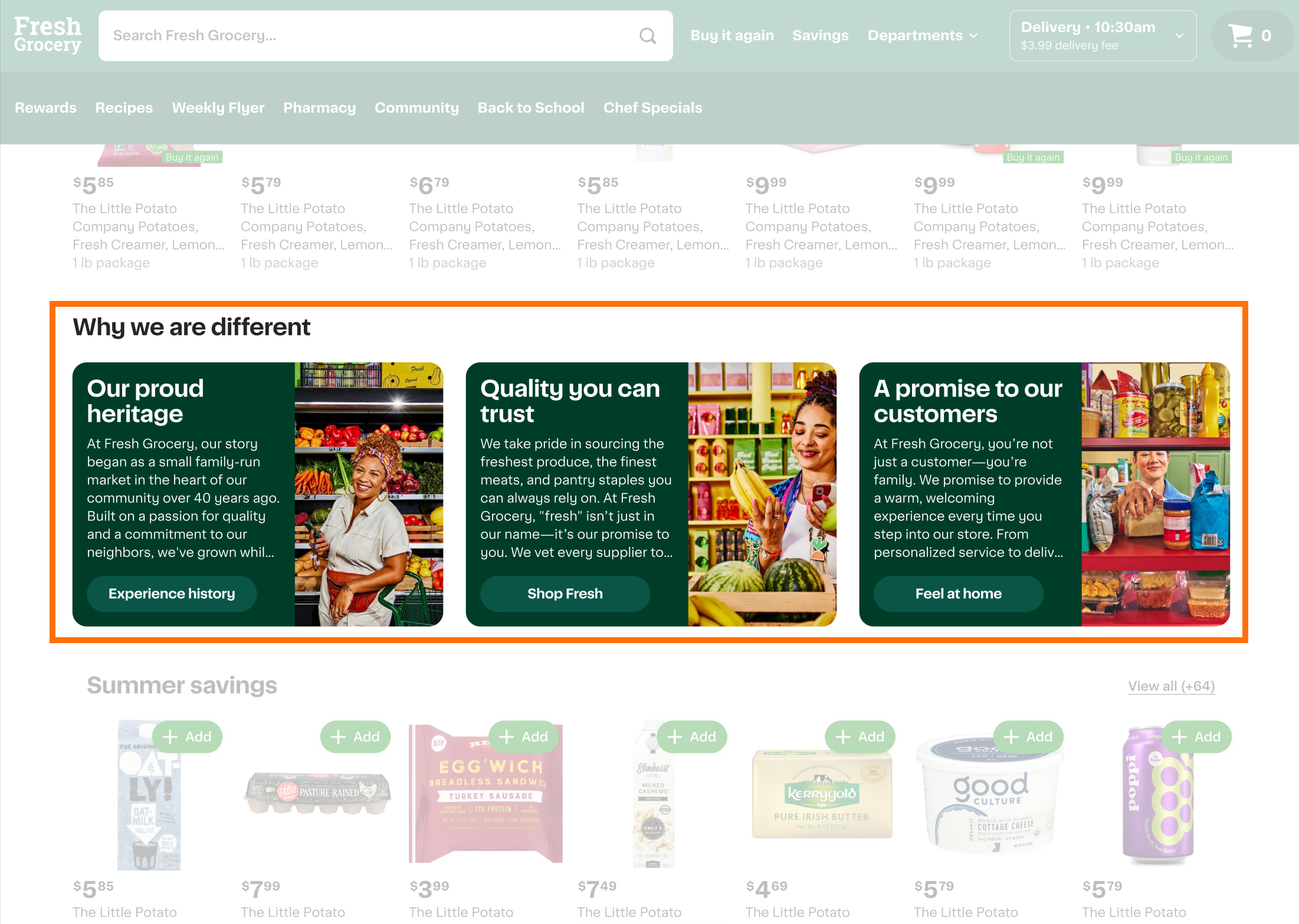
For more information, see Manage content pages, Manage your custom homepage, and Create drive awareness campaigns.
Direct link campaigns
You can now create direct link campaigns in the Instacart Platform Portal. Direct link campaigns let customers redeem an offer by clicking a link or scanning a QR code. No promo code is required. You distribute the link through any channel, such as email, paid social ads, or in-store printed materials with a QR code.
When a customer clicks the link, they're prompted to sign in. Eligible customers see a confirmation, and the offer is added to their coupon wallet. Customers who don't meet the campaign's targeting requirements see a message that the offer isn't available for them.
For more information, see Click-to-redeem offers.
Budget capping for offer discount campaigns
You can now set a lifetime budget on offer discount campaigns to automatically pause them when spending reaches your target. When a campaign reaches 95% of its budget, the campaign status changes to Serving Paused — customers no longer see new offers, but any offers already added to their coupon wallet can still be applied at checkout. When a campaign reaches 100% of its budget, the campaign status changes to Budget Paused and all campaign activity stops. If you increase the lifetime budget, the campaign automatically resumes.
Budget capping is available for offer discount campaigns using click-to-redeem, auto-redeem, or direct link redemption methods. Budget capping is automatically enabled when you set a budget.
For more information, see Create offer discount campaigns.
Enhancements
The following enhancements are available in this release.
Account type targeting and reporting for drive awareness and offer campaigns
Drive awareness and offer campaigns now support targeting by account type. Campaign audiences can include rules to target customers based on whether they have a personal or business account, whether they have accounts of both types linked, or whether they show signals of being a potential business customer.
Account type is also available as a reporting dimension in Custom Reports. The Completed orders, Basket, and Search datasets now include an account type filter to analyze performance by customer account type. Completed orders also includes a split-by account type option.
For more information, see Campaigns and offers, Performance dashboards, and Datasets and templates.
Instacart Platform Portal performance improvements
Instacart has delivered several performance improvements to the Instacart Platform Portal, addressing the platform stability and speed issues that retailers most commonly reported. The following improvements have been made:
- Higher availability. Instacart Platform Portal backend availability has significantly improved, so your teams can rely on the portal being accessible when they need it.
- Faster page loads. Page load times have been substantially reduced, so you can navigate the portal and complete tasks more quickly.
- Fewer session errors. The rate of user sessions encountering errors has dropped significantly, resulting in a smoother experience across order management, catalog management, authentication, and onboarding.
Tooling improvements for clickable flyers (Storefront Pro 5)
Clickable flyers now include improved bulk copy and bulk edit functionality. When you copy flyer blocks or apply bulk edits, changes now apply across all banners for a partner automatically. Previously, you had to manually copy blocks and apply edits to each banner individually. This improvement reduces manual effort for retailers with multiple banner configurations.
For more information, see Manage clickable flyers
Group-based order guide sharing and export filtering for business accounts
Order guide sharing for business accounts now supports groups, in addition to individual team members. When an order guide is shared with a group, all current and future members of that group have access. When a member joins or leaves a group, their order guide access updates automatically.
When exporting order history, administrators can now filter the export by group to analyze spending for a specific group.
For more information, see Business accounts.
Improved reorder experience
The add all items from a previous order experience has been updated to improve performance and reliability for customers.
Content pages now available on iOS and Android mobile apps (Storefront Pro 5)
Customers can now view content pages on iOS and Android apps with a new webview implementation. Previously, content pages were only available to view on mobile and desktop web. Your existing content pages are automatically available to mobile app customers without additional configuration.
To add content pages to your mobile app navigation, see Manage native app navigation.